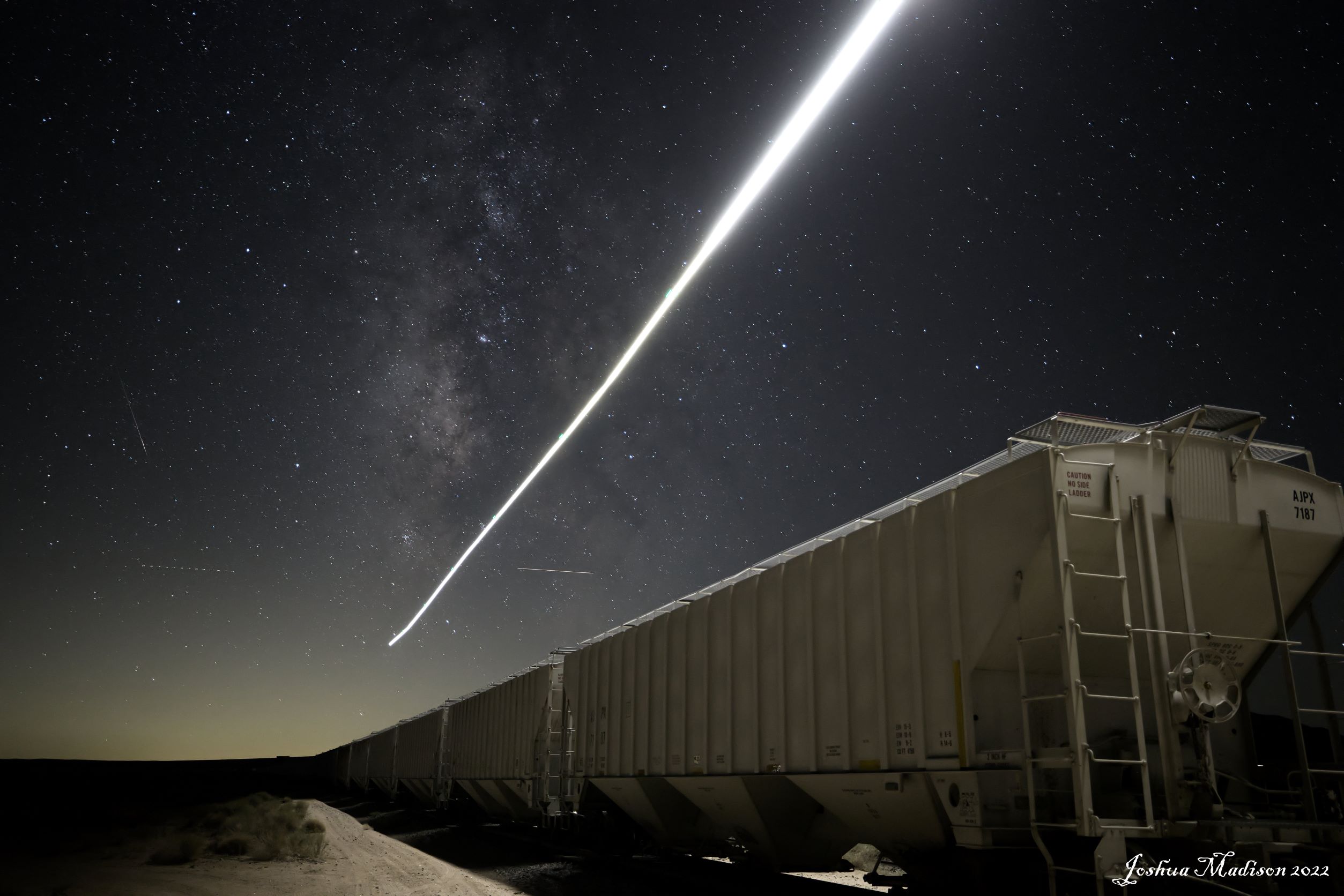

What is better than photos of the Milky Way? Well, it would be the Milky Way above a train being lit up by a drone of course. Most photographers are always looking for a nice foreground to include in their photos of the Milky Way. Photographers tend to use some sort of ambient light to accomplish this. That ambient light can be a flashlight, flashers, cell phones and just anything putting off light.
On this Milky Way photo shoot, I used a few different lighting techniques to light up the foreground. My main lighting for night photography is my Lume Cube Panel Mini. This light offers quite an array of light intensity to illuminate the scene. The intensity ranges from 1-100%. I only use 1% for lighting up my foreground for long exposure shots. 1% offers plenty of light on close-up foregrounds when shooting long exposures.
Another light I enjoy when shooting astrophotography is my uvBeast Black Light UV Flashlight. The UV flashlight adds an interesting blue color to the foreground. Since I was introduced to this light, I shoot at least one scene every night with this light.
All the lights mentioned above are used on the ground. I place these on a tripod, the ground, a solid object, car or just wave in my hand. Each of these light up the scene a little differently and we just have to experiment with the lighting. The most recent lighting I have started learning is utilizing the landing light on my drone. My DJI Mavic Air 2 offers a different perspective on foreground lighting. The DJI Mavic Air 2 as well as other drones has a landing light. This landing light can be used to light up the ground as the drone is flying overhead.
Searles Station Photo Shoot
Searles Station is a flat area in the desert about a mile east of highway 395 just south of Ridgecrest, CA. Many offroad enthusiasts enjoy this area with so many dirt roads traveling in all directions.
We drove to the end of the train tracks to setup our gear. After setting up on the train tracks, I took a few sunset photos as the colors were vibrant. Afterwards, I turned the camera to the south facing the Milky Way. The night sky was clear and begging me to point the camera at it.
One thing to always be aware of when hanging out in the desert at night is the local wildlife. One of my illuminated friends showed up to see the show I was about to put on.

In the photo below, I used the Lume Cube Panel Mini sitting on my chair to light up the foreground. The Milky Way can be seen modeling to the southeast of the trains.

Shutter Speed = 18 seconds
Focal Length = 35mm
ISO = 3200
The photo below was taken a little after 1am as the Milky Way had transited the sky more to the west. This photo was also stacked with 10 light images and 8 dark images.

Shutter Speed = 18 seconds
Focal Length = 35mm
ISO = 3200
Introducing the Drone Light Painting
Now it was time to breakout the drone and have fun flying around and lighting up the train.

I wasn’t sure how these photos would turn out which is why this was a trial-and-error run. I have to say, I think it turned out very nice.
I was only able to use a focal length of 35mm as my lens won’t zoom out to 15mm. Discover why my lens is broken by visiting my Joshua Trees and Milky Way Light Painting article. A wide-frame view will provide more sky view and better results with the drone. I will be trying this again with a wider angle lens at 15mm when I receive my lens back.
Below are some of the photos I took of the drone flying overhead. Enlarge a photo by clicking on it.


Aperture = f/2.8
Shutter Speed = 18 seconds
Focal Length = 35mm
ISO = 3200
Summary
Drone light painting is a lot of fun and challenging at the same time. It is important to have plenty of open airspace in order to avoid hitting any objects. Object avoidance sensors on the drone don’t detect objects in the dark.
To create brighter light I would fly lower to the ground or slower. For less light I would fly higher or faster. These were 18 second exposures so the camera detects a great deal of light in that timeframe.
Be sure to follow along as I continue this new to me style of photography along with all my others. Have you attempted drone light painting before? If so, I would love to hear your experiences and see the photos you captured. If you want, I would be more than happy to share your experience here and give you all the credit. Email me at phodeobug@gmail.com with your story and photos.
Let me know what you think of this photo shoot in the comments below.
I love photos of our galaxy. Although I have seen it in person when I was younger and living in an area with little light pollution, in-person sightings have been rare for me in recent years. Thanks for sharing.
Fortunately, I have the luxury to see these views most evenings with low light pollution. It makes stargazing and astrophotography much easier. I’m glad you enjoyed the article, thank you!