In order to view the Milky Way you must first be in a dark location. One of the darkest places in California is in Death Valley National Park. Death Valley is one of the best places to view the night sky due to its lack of light. The low light pollution makes Death Valley one of our best places to view the Milky Way.


We setup camp at the Panamint Springs Campground. This campground is located about 30 miles west of Stovepipe Wells. We planned to photograph the Milky Way in the Mesquite Flat Sand Dunes just past Stovepipe Wells.
Mesquite Flat Sand Dunes
We arrived at the Mesquite Sand Dunes around 11:45pm. When we got out we noticed a tremendous difference in the sky. Many more stars were showing and the only light we saw was from cars and other people.
We trekked across the dunes looking for a site to begin shooting. The first couple dunes were already taken by other photographers. After a few more minutes hiking we found a spot in a valley between dunes.
The sand dunes are fine loose sand so getting footing was difficult at times. The loose sand also made it easy setting up the tripods.
We were setup and starting focusing our cameras and looking for the right composition for our photos. We tried many different angles and heights. Some photos were taken with dunes only and others we found bushes.
The dark skies were relaxing and the sand drowned out all sound. It was a very relaxing evening with no sound and beautiful dark skies.
Scorpions In The Night
Another interesting find during the night were scorpions. Yes, scorpions live in the desert. Using a uvBeast V3 365nm Blacklight we were able to find a handful of scorpions in surrounding areas. Most of them were located around rock structures, including our camp site.
Below are a few scorpions I took photos of with my cell phone under the UV light. It is really neat how they glow and the rocks also put off interesting colors.


Milky Way Photos
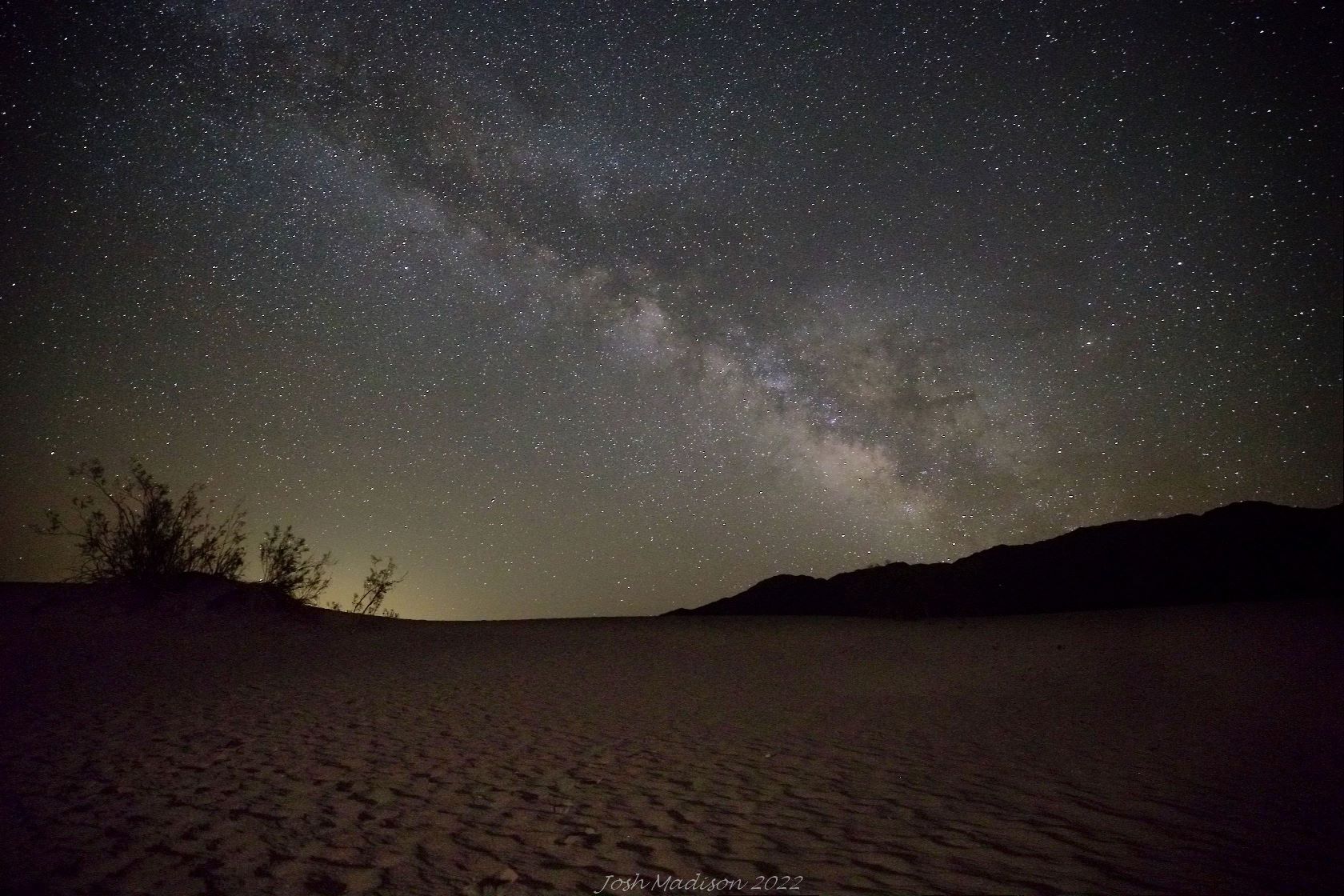
The Milky Way looked amazing stretching across the sky from north to south. The core was appearing in the southeast.
This was my second attempt to shoot the Milky Way. I was excited to test out my new Canon RF 15-35mm f/2.8 lens this night. The amount of stars I was able to see in my photos compared to my Canon RF 24-105mm f/4 lens was unreal.
So, before you see the photos I will apologize for forgetting to do something important. Yes, I did a dumb thing that astrophotographers should always remember to do. I forgot to take my dark photos to help eliminate noise in the photos. Taking dark photos is important for night sky photography. Another mistake I made was I never changed my ISO settings. I changed aperture, focal length and exposure time but not ISO. This was one of those moments I messed up and I have learned.
These are the best images I was able to clean up some without the ISO changes and dark images. The light over the horizon is from Las Vegas. Another month or so we should be able to have a better view to the south with less light pollution.


Conclusion
I learned a few things on this trip to Death Valley. One, my new Canon RF 15-35mm f/2.8 lens is amazing and really collects much more light. More detail in the Milky Way appeared in the photos with this lens. Second, I need to change the settings on my camera based on the lens being used. Well, this was another lesson in life where I learn by mistake.
I can take longer exposures with the new lens and lower the ISO for better photos. The longer exposures will show more light on its own without increasing the ISO.
Overall, the trip was a lot of fun and we were both tired when it was all over. Neither of us slept more than two hours in the tents. After waking from a two hour sleep we packed up and went home.
This was my 2nd ever photo shoot of the Milky Way. Other than the noise due to high ISO I was very pleased. I look forward to the next opportunity and will be sure to correct errors from this trip.
Be sure to rate this article below by clicking the appropriate stars. Let me know in the comments below if you have any questions or comments related to this article. I would love to know what you think of this article. Until next time!