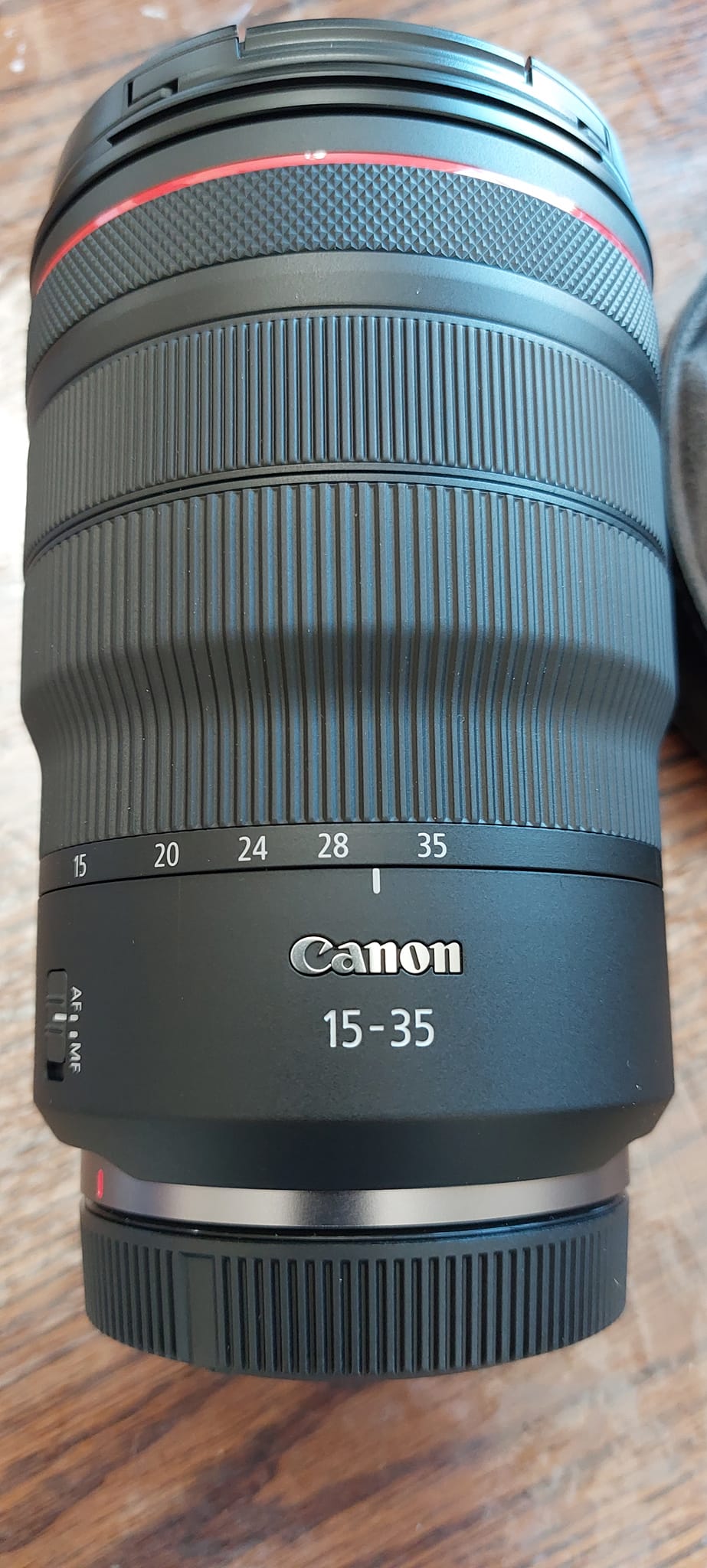
Focal length of a lens is the distance between the lens and the camera sensor when the subject is in focus. This is usually measured in millimeters (e.g., 24 mm, 50 mm, or 100 mm). If you own a zoom lens the minimum and maximum focal lengths will show on the lens. The image below is my Canon RF 15-35mm lens.

A wide-angle view captures larger areas, small angle view captures smaller areas. Changing the focal length changes the angle of view. The shorter the focal length (e.g. 15 mm), the wider angle of view captures a larger area. The longer the focal length (e.g. 35 mm), the smaller angle of view captures a smaller area and the subject appears closer.
Difference Between Short and Long Focal Length
A short focal length will capture a larger area while a long focal length captures a smaller area. In this article we are covering two types of lenses, a wide angle and telephoto. The table below breaks down the two lens types.
| Lens | Angle of View | Focal Length | Area Captured | Lens Size |
|---|---|---|---|---|
| Wide Angle | Wide | Short | Large | Small |
| Telephoto | Small | Long | Small | Large |
A telephoto lens with a focal length of 70-200mm offers the widest angle at 70mm and smallest angle at 200mm. If you want to capture a large area such as landscapes then a wide-angle lens is preferred. I shoot landscapes mainly with my 15-35mm wide-angle lens. When I want my subject to fill the frame, I use my 100-500mm telephoto lens.
The photos below were taken with The Needles as the main subject with three different focal lengths. The photos were taken with my 24-105mm lens. The photos were taken with focal lengths of 24mm, 72mm and 105mm. All photos were taken from the same location. You can see the difference between each focal length of the same subject. The 24mm captures a larger view of the landscape while the 105mm makes the main subject appear closer.


Summary
The best way to sum up focal length is, shorter=larger area of view and longer=smaller area of view. When focusing on a specific subject such wildlife or person, you will want a longer focal length. If you want to capture a large area such as landscape or the night sky you will want a shorter focal length.
I hope you found this article useful and it gives you a better understanding regarding focal lengths. Let me know what you think in the comments below and be sure to rate this article.
Do you want to know how to make better photos? If so, check out my article Using Auto Exposure Bracketing for Better Photos.